
Open-source product

MicrOS

Simple, open, embedded. A lightweight open-source real-time operating system for microcontrollers and small systems, designed to stay tiny, transparent, and hackable.

MicrOS is a public embedded-systems project built to make low-level operating-system concepts easier to inspect, explain, port, and extend without hiding them behind unnecessary weight.

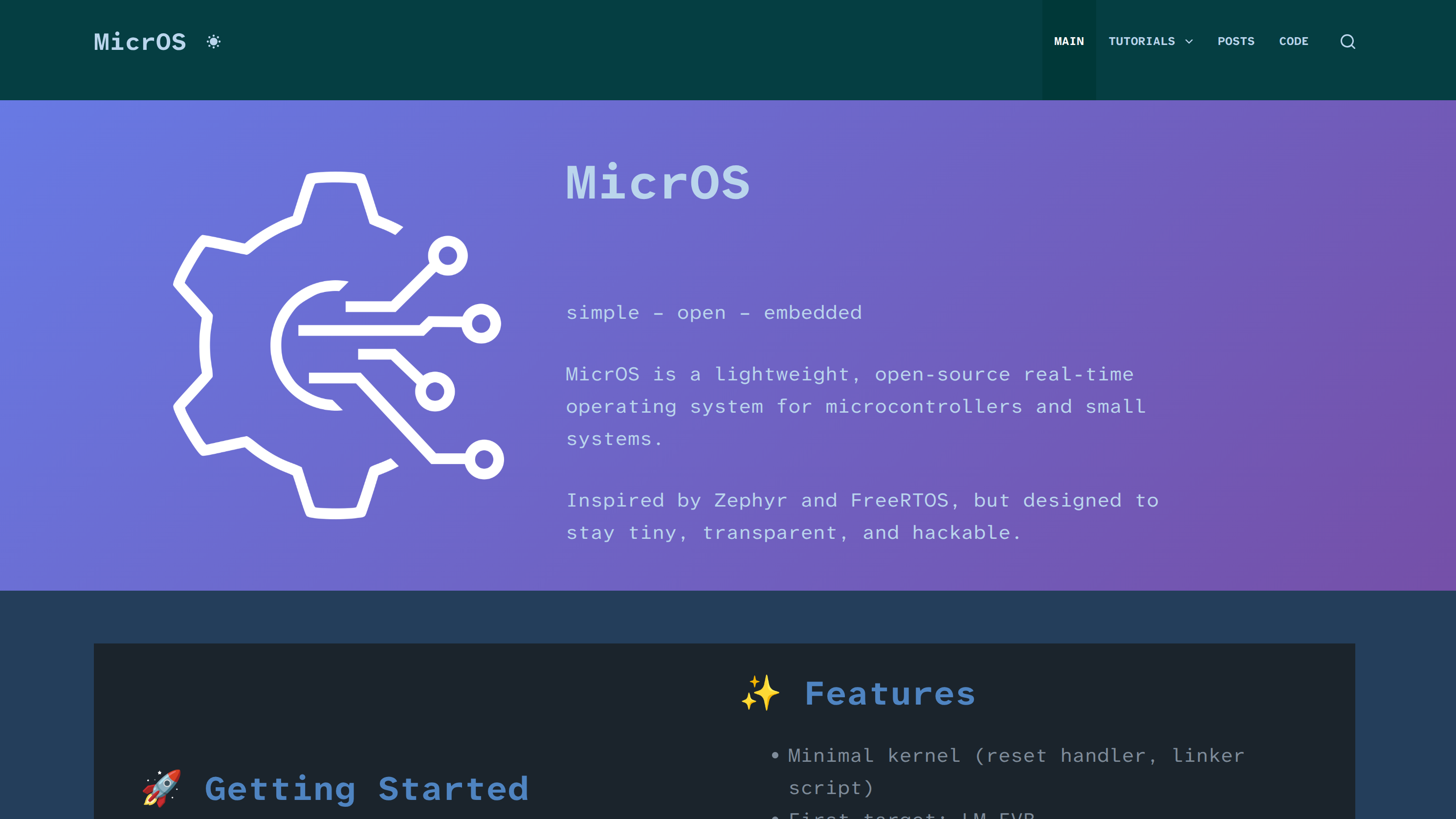
MicrOS website screenshot

Execution surface

Built for public embedded learning without hiding the hard parts.

RTOSARM Cortex-MQEMUCMakeNinjaOpen sourceEducation
  • Minimal kernel surfaces including startup and initialization flow
  • Board-oriented build configuration with CMake toolchain routing
  • QEMU-backed sample execution for fast iteration
  • Driver-model and concurrency documentation for contributors

Why it matters

  • Shows practical low-level engineering taste: understandable startup flow, linker configuration, and kernel boundaries
  • Demonstrates public technical communication, not only implementation, through docs, roadmap, and contributor-facing material
  • Acts as a strong signal for embedded clients who value portability, transparency, and direct engineering judgment

Project snapshot

A public RTOS project that shows how G2Labs approaches embedded architecture when clarity matters.

Visit the GitHub repository
MicrOS homepage and documentation preview
MIT

licensed

QEMU + HW

execution path

CMake + Ninja

build flow

ARM / POSIX / RISC-V

portability direction

Who it is for

Useful for engineers who want to understand the moving parts, not just consume them through a black box.

  • Engineers learning RTOS building blocks such as startup flow, scheduling, and drivers
  • Embedded developers who want a small public codebase they can actually read end to end
  • Teams interested in the engineering taste behind G2Labs delivery work: clarity, portability, and lean build systems

Project site

microsproject.dev

The live site explains the project scope, public intent, and overall direction without hiding the technical core.

Quickstart

Getting Started

The docs are worth opening because they show how the project is meant to be built, run, and understood in practice.

Source code

Public repository

The repository is the strongest proof surface because it exposes the architecture, build flow, and contributor-facing engineering decisions directly.

Project qualities

MicrOS is strongest when judged as a transparent engineering surface, not as a marketing-only open-source announcement.

Clarity-first architecture

The project is intentionally shaped to keep startup code, linker flow, kernel surfaces, and board support understandable rather than hidden behind layers of framework machinery.

Educational in public

MicrOS is meant to be learnable in the open, with documentation, samples, and governance visible to contributors and readers instead of buried in private notes.

Real embedded constraints

It is not a toy detached from practice: the project is built around real toolchains, board configuration, linker scripts, QEMU execution, and hardware-oriented bring-up.

Representative surfaces

A few concrete areas that make the project useful as proof, not only as a concept.

MicrOS surface

Minimal kernel surfaces including startup and initialization flow

MicrOS surface

Board-oriented build configuration with CMake toolchain routing

MicrOS surface

QEMU-backed sample execution for fast iteration

MicrOS surface

Driver-model and concurrency documentation for contributors

MicrOS surface

Public roadmap, contribution guidelines, and security process

Why it matters for clients

MicrOS is also a public proof surface for the embedded architecture and communication style behind G2Labs.

Execution signal

Shows practical low-level engineering taste: understandable startup flow, linker configuration, and kernel boundaries

Execution signal

Demonstrates public technical communication, not only implementation, through docs, roadmap, and contributor-facing material

Execution signal

Acts as a strong signal for embedded clients who value portability, transparency, and direct engineering judgment